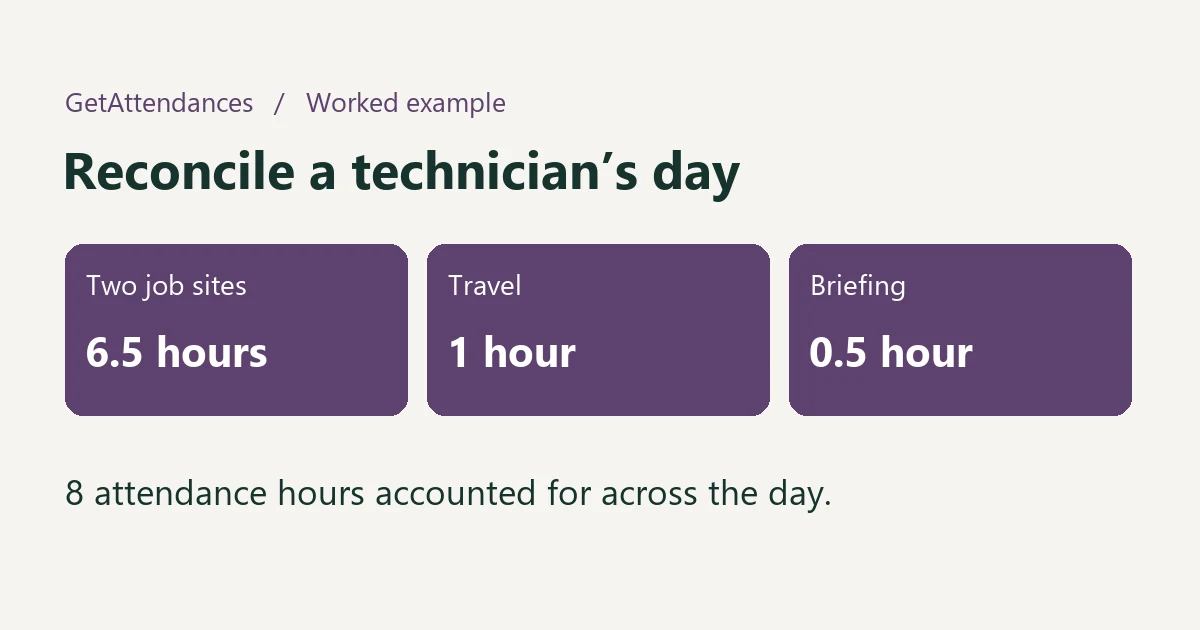
Reconcile a technician’s day
A technician clocks in at 08:00 and leaves at 17:00. After a confirmed one-hour unpaid break, the attendance record shows eight working hours. The project sheet lists three hours on Site A and three and a half on Site B. The remaining 90 minutes need an explanation.
| Allocation | Hours |
|---|---|
| Site A installation | 3.0 |
| Site B maintenance | 3.5 |
| Travel between jobs | 1.0 |
| Internal briefing | 0.5 |
| Total allocated | 8.0 |
In this example the supervisor confirms the travel and briefing. Finance can then apply the appropriate costing rules. Allocated time and billable time are separate decisions: a company may record internal briefing time without billing it to a client.
What if project hours exceed attendance?
Look for overlapping job timers, duplicated entries and activities booked against the wrong date. If Site A lists 08:00–12:00 and Site B lists 11:30–14:00, resolve the half-hour overlap against the work order. Preserve the original entries and the supervisor’s decision.
Ask for two exports at the demo
Request a shift-level attendance export and a job-level allocation example. Check employee identifiers, local dates, time units and who approves each record. Confirm whether project costing requires another system. An attendance report alone cannot establish what a client should be charged.
One attendance record across two emirates
For a Dubai-based technician visiting a Sharjah client on the same day, use one shift reference and separate job codes for each visit. In the example above, the supervisor can assign the confirmed hour between jobs to travel and leave the half-hour briefing under an internal code. Finance can then check the client agreement before billing. Crossing an emirate boundary by itself does not identify which job should absorb the cost.